
The HVAC marketing ideas that book the most jobs are timed to the season: tune-up reminders before peak heating and cooling, maintenance-plan offers to past customers, and welcome mailers to new homeowners. Each one works better as direct mail when every piece is tracked to calls, booked jobs, and revenue, so you keep the ideas that pay and drop the ones that do not.
If you run an HVAC company and need HVAC advertising ideas that fill the schedule in every season, not just when the weather breaks, this playbook is for you. Below are the ideas we use for HVAC direct mail, grouped by season, customer list, and neighborhood, plus what an HVAC postcard should say and how to know which idea worked.
What are the best HVAC marketing ideas for direct mail?
The best HVAC marketing ideas for direct mail are the ones matched to a real moment in the home: a shoulder-season tune-up, a membership renewal, a new homeowner move-in, or a neighbor who just saw your truck. Idea lists that ignore season and list quality turn into noise. Idea lists that track every piece to booked jobs become a playbook you can repeat.
Jump to the ideas in this guide:
- Pre-season AC tune-up reminder
- Pre-season furnace tune-up reminder
- Extreme-weather “we’re booking now” mailer
- Maintenance membership signup and renewal
- Win-back for customers you have not seen in a while
- Unsold estimate follow-up
- New mover welcome mailer
- Radius mail around recent installs
Those eight cover most of the HVAC marketing strategies contractors ask about: seasonal promotion ideas, membership growth, marketing ideas for an HVAC business that needs new customers, and neighborhood proof around jobs you already won.
Seasonal HVAC marketing ideas
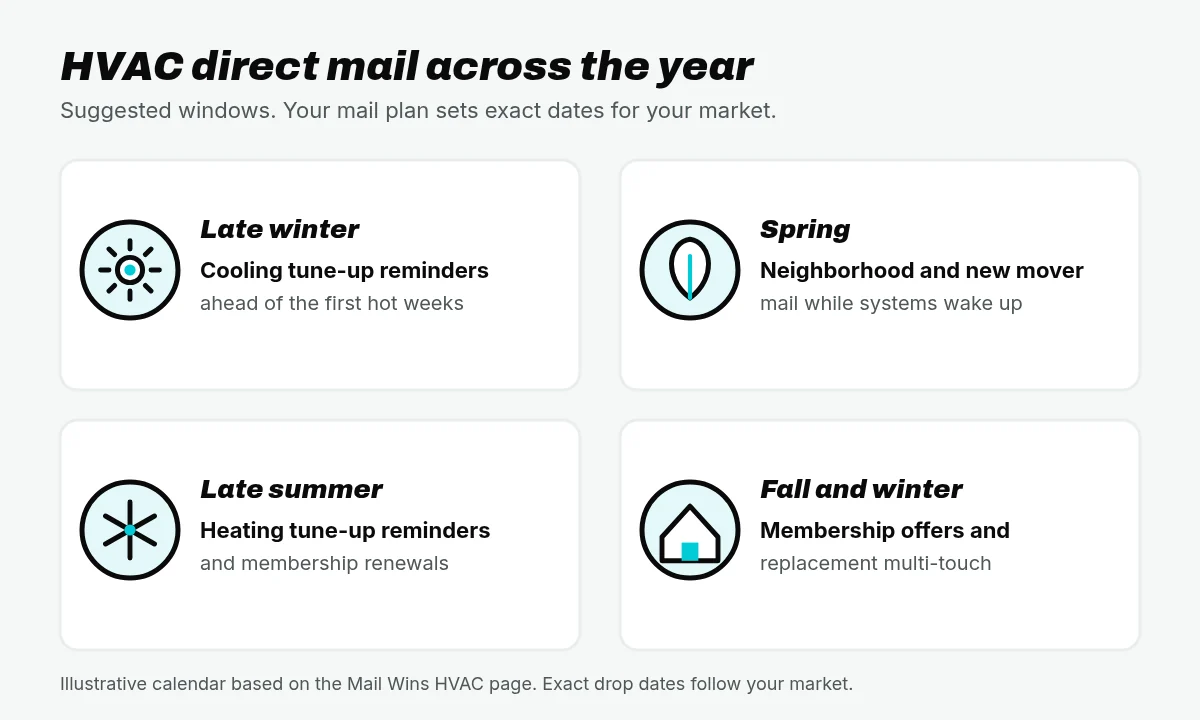
Season drives HVAC demand. Mail that lands before the peak fills the schedule. Mail that lands after the peak fights for attention while every competitor is shouting the same offer. The windows below follow the same pattern as the Mail Wins HVAC page: late winter for cooling tune-ups, spring for neighborhood and new mover drops, late summer for heating tune-ups and renewals, and fall and winter for membership and replacement-focused sequences.
Think of the year as four booking problems, not one annual blast. Cooling reminders protect spring capacity. Heating reminders protect fall capacity. Neighborhood and new mover mail keeps new names coming in between those peaks. Membership and replacement sequences keep revenue from depending only on breakdown calls.
Pre-season AC tune-up reminder
Send cooling tune-up reminders in late winter, before the first stretch of hot weather. Past customers and membership prospects are the right list. The offer is a scheduled AC tune-up, heat pump check, or cooling system inspection, with a clear booking window so the phone rings while your calendar still has open days.
Homeowners put off maintenance until the first miserable afternoon. Your job is to be in the mailbox before that afternoon, with one offer and one number. If you also sell maintenance agreements, the same drop can introduce the plan after the tune-up books, or lead with the membership for customers who already trust you.
What to put on the piece:
- The service (AC tune-up or cooling system check)
- A real deadline or booking window
- The tracked call number for that drop only
- A QR code to the same campaign landing page
- A short line on what the visit covers (filters, coils, refrigerant check, thermostat, as your techs actually do it)
Pair this with Maintenance Club Growth when you want the same drop to sell or renew a maintenance agreement, not only book a one-time visit.
Pre-season furnace tune-up reminder
Send heating and furnace tune-up reminders in late summer, before the first cold snap. Same logic as the AC drop: reach past customers while your schedule is still open, and give them one number and one offer.
Heat pump homes get the same treatment with language that matches the equipment. If your market mixes furnaces and heat pumps, split the list by equipment type when you have that data, or keep the copy broad (“heating system tune-up”) so the piece still fits.
Late summer is also when membership renewals compete with back-to-school noise. Keep the piece scannable: offer, deadline, tracked number, QR code. Save longer membership explanations for a letter pack or a second touch in a multi-touch sequence.
Extreme-weather “we’re booking now” mailer
When a heat wave or cold snap is already in the forecast, a short, urgent mailer can catch homeowners who waited. Keep it honest: you are booking service now, you cover their ZIP codes, and the tracked number on the card is the fastest way to get on the schedule.
This idea works as a supplement, not a plan. The seasonal tune-up drops above are the backbone. The weather mailer is the surge move when demand spikes and you still have capacity, or when you want to steer overflow toward memberships after the emergency call.
Customer list HVAC advertising ideas
Your customer list is often the highest-intent audience you have. These HVAC advertising examples reuse names you already earned: past customers, members, and people who got an estimate but never booked. You already paid to acquire them once. Mail that brings them back for a tune-up, a membership, or a second look at an estimate usually costs less attention than cold prospecting, and the tracked number still tells you which drop did the work.
Maintenance membership signup and renewal
A maintenance agreement (also called a membership, service agreement, or maintenance club) turns one-time tune-ups into a recurring relationship. Mail works on both sides of that sale:
- Signup: explain what the plan covers, when visits happen, and how to join, with a tracked number and QR code on the piece.
- Renewal: remind members before the plan lapses, with the same tracking so you can see which renewals came from mail.
Mail Wins runs this as Maintenance Club Growth: sell, renew, and remind on the same program, with every call matched to membership sign-ups and revenue in your CRM.
Win-back for customers not seen in a set period
Customers who have not called in a long time still know your name. A win-back postcard or letter pack asks them back for a tune-up, a membership, or a system check, without pretending they are brand new.
Set the “not seen” window from your CRM (for example, no job in 18 or 24 months) and keep that rule the same from drop to drop so you can compare results. Use a tracked number unique to the win-back campaign so those calls do not blend into your active-customer mail.
Unsold estimate follow-up
When a homeowner got a replacement or repair quote and went quiet, a short follow-up piece can reopen the conversation. Keep the offer tied to the estimate (equipment replacement, financing options if you offer them, or a second look at the quote) and put the tracked number on the piece so you know the mail, not a random Google search, brought them back.
Letter packs give you more room than a postcard when the job is a system replacement. See formats for postcard sizes and letter packs that fit estimate follow-ups.
Neighborhood and new-customer ideas
New demand comes from homes that have never called you. Two Mail Wins programs cover most of that: new movers and radius mail around jobs you already completed. New Customer Prospecting covers broader addressed lists of homeowners in your area who are not yet customers.
New mover welcome mailer
New homeowners need a contractor before the first breakdown. A welcome mailer that arrives early, with a clear offer (first tune-up, membership intro, or “save our number”), puts you in the drawer while they are still setting up the house.
Mail Wins New Mover Marketing targets recent move-ins in your service area. Every piece carries built-in tracking so calls and jobs from new movers show up in your Mail Wins dashboard by campaign and drop.
Radius mail around recent installs
When you finish a job, the homes nearby are a natural audience: they saw the truck, they have similar houses, and a neighbor referral carries weight. Radius mail sends a targeted address list within a radius of that job (or your office), not a blanketed route. You choose the center point (the install address or your shop) and the distance that matches how far you want to work.
That is Neighborhood and Radius Marketing. Pair it with Customer Referral Programs when you want happy customers to hand a tracked piece to a neighbor, and with multi-touch campaigns when the same homes should see a planned sequence rather than a single drop. Property age and homeownership filters from the list vendor can tighten the drop further when you only want owner-occupied homes in a given age band.
A single radius drop after a visible install is often enough to test the idea. If calls book, expand the same creative to the next jobs. If they do not, change the offer or the radius before you scale.
What should an HVAC postcard say?
A strong HVAC postcard is short. It answers five questions and stops. HVAC advertising ideas fail on the card when the front tries to sell every service you offer. Pick one primary action. Everything else supports that action or gets cut.
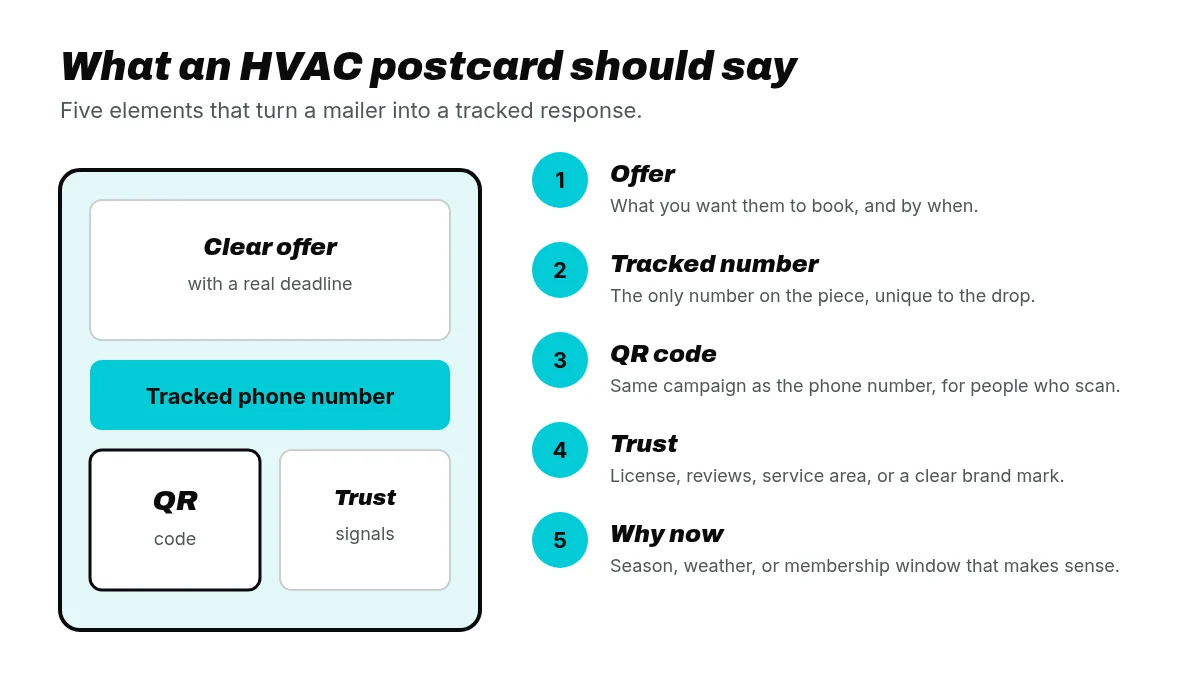
- Offer. What should they book (tune-up, membership, estimate follow-up), and by when?
- Tracked number. The only phone number on the piece, unique to that campaign and drop.
- QR code. Opens a landing page for the same campaign, so scans and calls land in one report.
- Trust. License, reviews, service area, or a clear brand mark. Do not invent ratings.
- Why now. Season, weather, membership window, or “we just finished a job on your street.”
HVAC postcard templates fail when they crowd the card with every service you offer. One primary offer beats a menu. Postcard sizes Mail Wins runs for contractors include 6.25×9, 6.25×11, 6.5×9, 8.5×11, 12×15, 12×14, and mini postcards, plus letter packs when the message needs more room (formats).
When should HVAC companies send direct mail?
Use the seasonal map, then lock exact drop dates to your market and capacity:
| Window | Primary HVAC mail |
|---|---|
| Late winter | Cooling (AC) tune-up reminders |
| Spring | Neighborhood radius mail and new mover drops |
| Late summer | Heating (furnace) tune-up reminders and membership renewals |
| Fall and winter | Membership offers and replacement-focused multi-touch |
Suggested windows only. Your mail plan sets exact dates for your climate, permit calendars, and crew size. Contractors in mild markets often compress the spring and fall windows; contractors in extreme climates often add the weather surge mailer between the main drops.
If you run the same idea more than once a year, change the tracked number by drop so you can tell which send booked the work. That discipline is what turns HVAC promotion ideas into a measured plan.
How do you know which HVAC marketing idea worked?
You know which idea worked when each mailing has its own tracked call number (and QR code where it fits), and those responses are matched to booked jobs and revenue in your CRM. Pieces mailed is not a result. Booked tune-ups, memberships, replacements, and the revenue on those jobs are.
Read the report the same way every time:
- Which seasonal drop made the phone ring?
- Did those calls book, or did they stall on price, timing, or capacity?
- Which program (tune-up, membership, new mover, radius, referral) produced the jobs you wanted?
- What should you mail again next season?
Mail Wins builds that tracking into every piece and reports calls, booked jobs, and revenue in your Mail Wins dashboard. Integrations with systems such as ServiceTitan and Housecall Pro keep the job records where your team already works. For the full setup (unique numbers, QR codes, call tagging, CRM matchback, and the report columns), see how to track direct mail from mailbox to booked job.
HVAC marketing ideas FAQ
How often should HVAC companies mail?
Most HVAC companies mail around the seasonal windows above: cooling reminders before summer, heating reminders before winter, plus new mover and radius drops as jobs and move-ins happen. Exact frequency depends on your list size, capacity, and which programs you run. Your mail plan sets the calendar for your market.
Do HVAC postcards still work?
Yes, when the list, offer, and timing are right, and every piece is tracked to calls and booked jobs. A postcard that cannot be tied to revenue is only a hope. A postcard with a unique tracked number and a CRM match shows you whether to mail it again.
What offer works best for tune-ups?
The offer that matches the season and your capacity: a clear AC or furnace tune-up with a booking deadline, or the same visit framed as the start of a maintenance membership. Test one primary offer per drop. Tracking tells you which offer booked jobs in your market; there is no single national winner.
How many homes should an HVAC company mail?
Enough to fill the open slots on your schedule for that offer, without flooding a crew you cannot staff. Start from capacity (jobs you can actually run in the weeks after the drop), then size the list and the radius or mover window to match. Mail Wins sets the list around your area and program on the consultation, not from a one-size count.